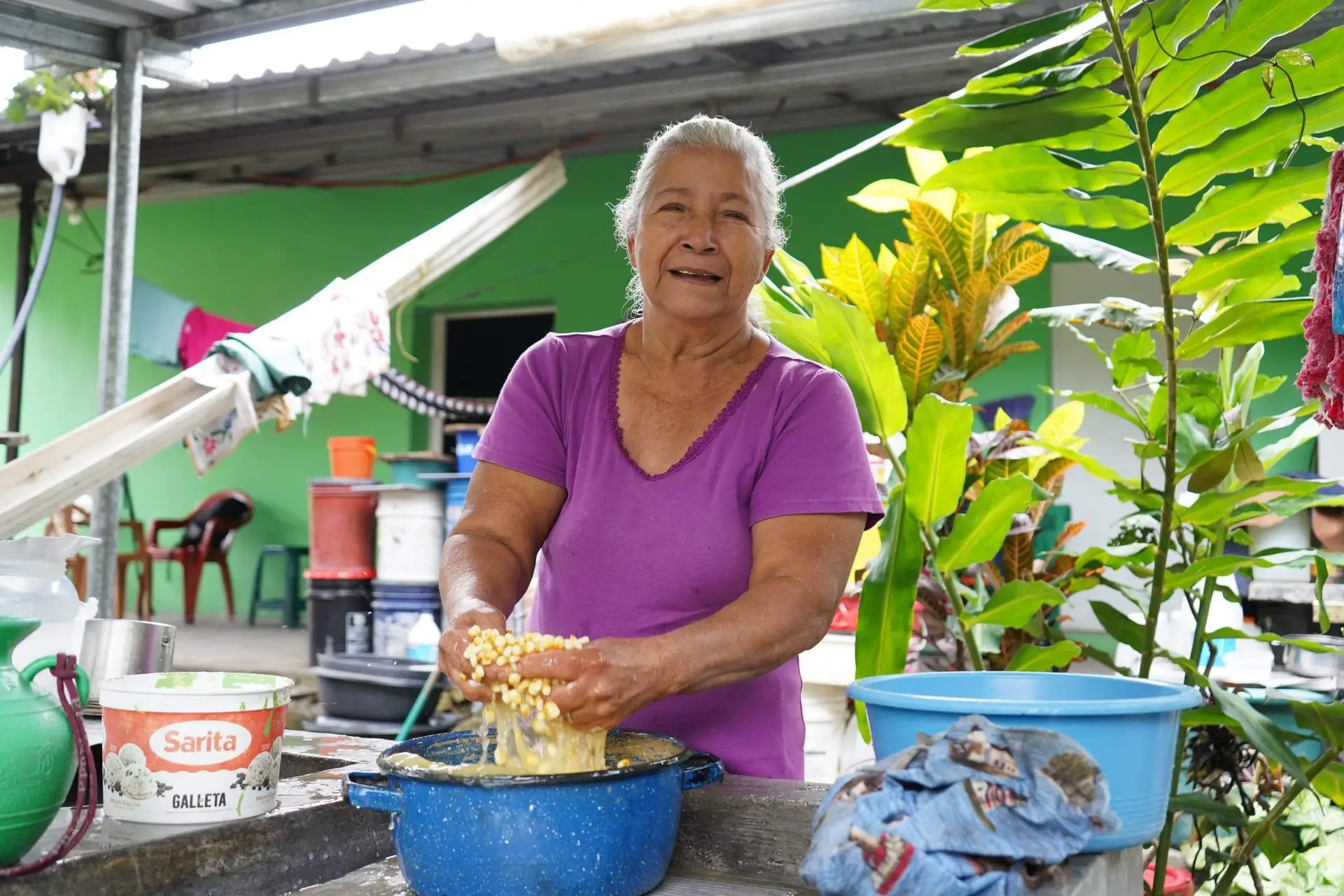
The life of Reina Caballero López (68) has been one of hard work and sacrifice. Since childhood, she worked in the fields to earn her daily bread, and later, she spent decades as a domestic worker. She raised her two children—now 48 and 35—on her own, always with the strength and dignity that define her.
Just a few days ago, Reina welcomed us into her home in El Derrumbo, a village in Santa Rosa de Copán. With a shy smile, she began to share one of the hardest chapters of her life: her battle against breast cancer.
It all started five years ago. While bathing, she noticed a small lump in her right breast. Since it caused no pain or discomfort, she thought it wasn’t serious. But when she went to the Public Health Center—where CAMO has its Women’s Care Services—the doctors recommended she get a mammogram right away.
“Five days later they called me to pick up the results,” she recalls. In that moment, she had a feeling: something wasn’t right. The diagnosis confirmed her fears—breast cancer.
Fear took hold of her, especially when she thought about the cost of treatment. But her faith was stronger than her fear. “God was my first doctor,” she told us with conviction.
The doctor reassured her: “Don’t worry, there is treatment for your illness.” And so began a long journey in San Pedro Sula and Santa Rosa de Copán: chemotherapy every 21 days, a mastectomy, and later, radiation therapy.
It was a painful process. “I lost a lot of weight because I couldn’t even eat during treatment. But even then, I never stopped going to church or believing that God would heal me.”
Today, Reina is living proof that early detection can make the difference between life and death. Her message is clear and full of hope: a mammogram can save lives.
In Honduras, about 1,260 new cases of breast cancer are diagnosed every year, and at least 400 women die from the disease, according to the Honduran Breast Cancer Foundation (Funhocam). That is why programs like CAMO’s Women’s Care Services—which last year allowed 1,236 low-income women to access a mammogram—are more than just health services: they are opportunities for life.