
Camo In Focus, November- December 2019
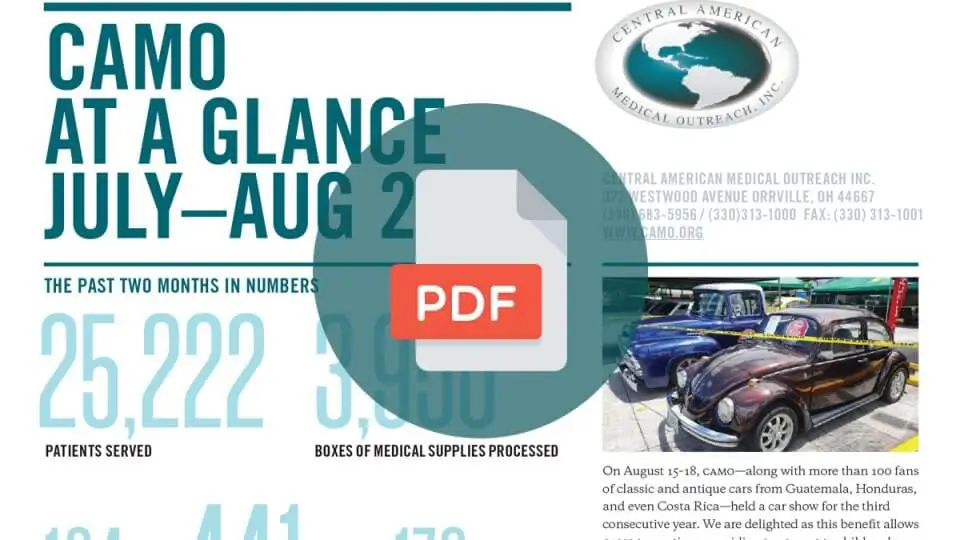
Our impact in numbers!
In the last two months we have provided medical services to 23,897 patients. We are grateful for the support you have given us to make this possible. Thank you!
Our impact in numbers!
In the last two months we have provided medical services to 23,897 patients. We are grateful for the support you have given us to make this possible. Thank you!

Our impact in numbers!
In the last two months we have provided medical services to 29,546 children and adults. We are grateful for the support you have given us to make this possible. Thank you!
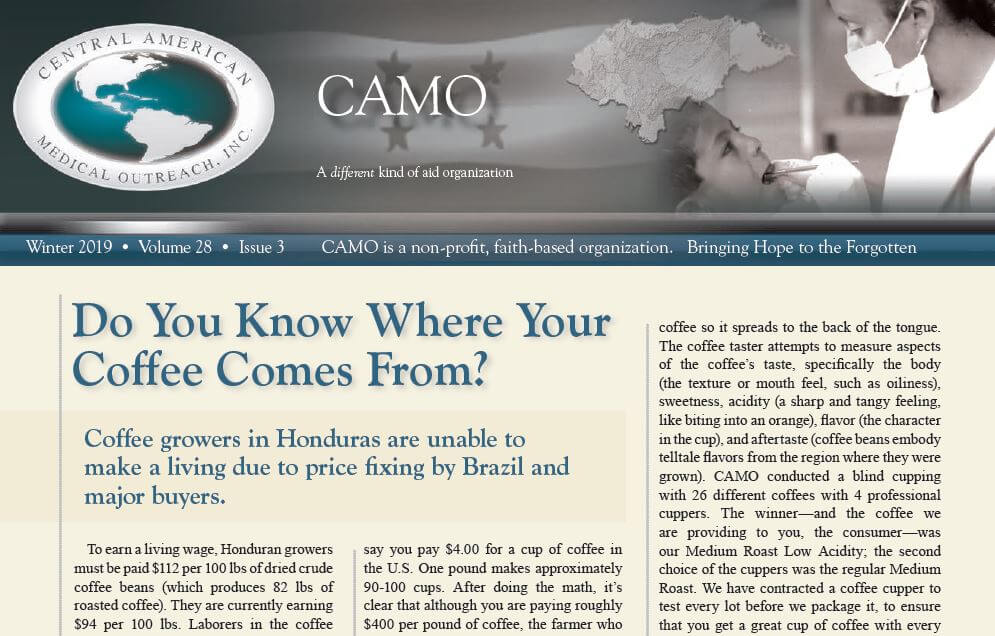
We are happy to share with you our latest news and updates from our recent US medical brigade in Honduras. We are grateful for the many services we have been able to provide to the people we serve with our 18 medical programs, training and education and community development projects.
Please, click the link to read our Winter newsletter. Thank you for your continuous support and donations.
She stumbled into the clinic with a heavy bag across one shoulder and a tiny twelve year old girl, Nelly Ruby, in her arms. Nelly had just been just discharged from the Hospital de Occidente—but Maria knew she needed follow-up care. So she came to camo to meet with our nutritionist, Bianca Ramirez. After evaluating Nelly, Bianca realized that the child was severely malnourished and urgently needed nutritional treatment. Born with cerebral palsy, Nelly was left alone in the world
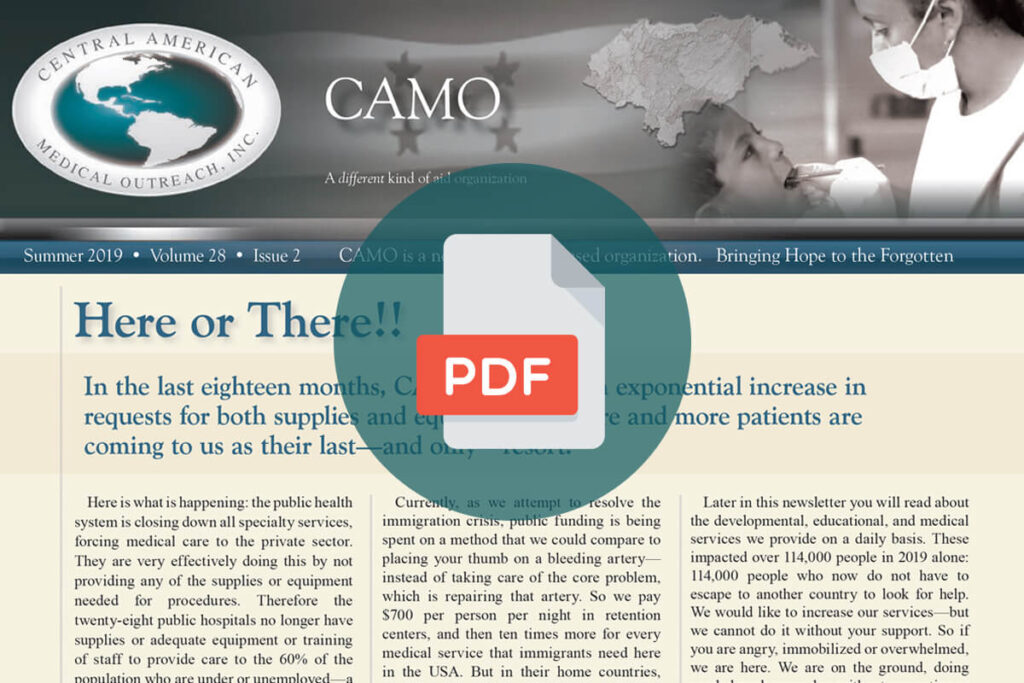
“I have experienced many parts of the world, yet none have had the same effect as the trip we’ve had to Honduras. The people, the environment, the place itself has changed me. It has taken the blindness away and replaced it with vision. I have a new idea of the world, one I wish for others to gain. Honduras has changed me in a way no other place has, one that will remain in my heart the rest of my life” – Jake
Jake is a recent member of an international trip with CAMO from the Youth Group of the Salem Mennonite Church that supports our mission. To read more experiences like his, please take a look at our recent newsletter and share our stories of hope and recovery… your support has made these stories possible bringing hope to more families
Founder’s note
CAMO has witnessed so many coincidences this year—events that might
seem easily explainable, but if you consider how many things had to happen
at exactly the right time, you might come to the same conclusion we did:
faith is not just a word.
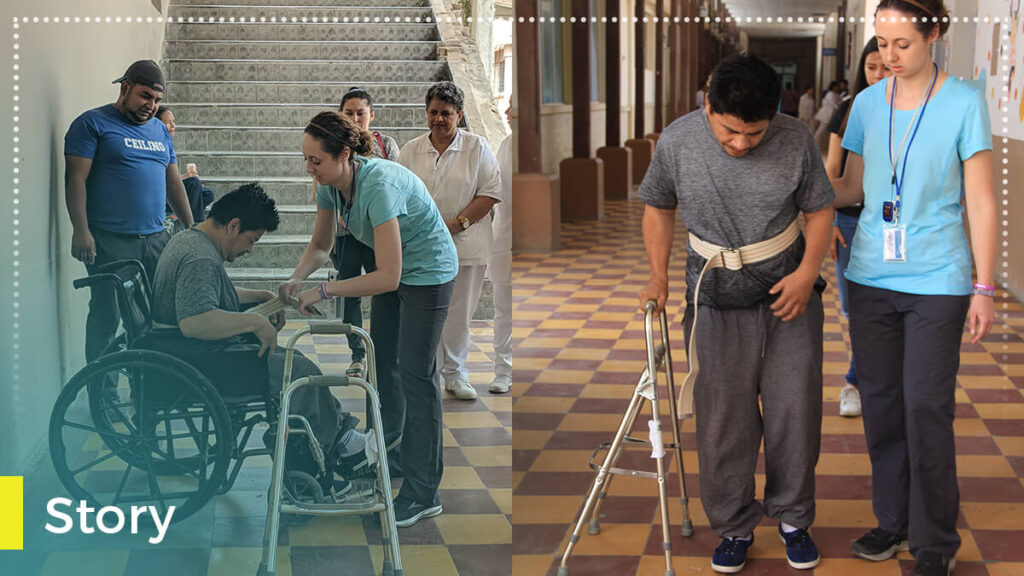
At the end of the first full day’s work for the medical teams, I tried to touch base with everyone, as I always do at the end of their work day. That first evening, I sat with Hannah Loder and Rachel Foltz. Rachel, a Physical Therapy Technician, told me that the staff at the rehab center wasted no time in putting her right to work! Her passion for her work evident, she shared her most exciting point of the day.
Jose Antonio, a young man of forty-nine, had a stroke on the job and lost movement on his left side. Confined to a wheelchair, he had not walked since the day of his stroke three months prior. Rachel, after evaluation, felt it was time for him to stand and attempt a step. So with support and the parallel bars he stood and was able to take a step . . . and then two . . . and then three. He did not want to sit down! But to continue walking, he would need a device he could use at home. Rachel asked, “Does CAMO have what we call a half walker? That’s what he needs in order to be mobile.”
My heart sank because in my twenty-six years of loading and unloading containers, I had never seen the device she was requesting. The next morning, I searched the Honduras warehouse—but found nothing even close to what she needed. Later that morning, we learned that our shipping container had cleared customs; as the container was unloaded, I searched every corner.
Alone, I went up to our attic area, unable to believe we could not help Jose. I actually said aloud, “God, you have always provided. Why have you not provided this device for this man?” After this prayer, I went back down the steps. Mark Gorman, our Prosthetic/Orthotic counterpart, came barreling towards me in his wheelchair. Across his lap was a device he was carrying to store with the other walkers. I said, “Mark, stop! You have just what I have been looking for.” It was the half walker Rachel had requested.
A great pause came over me. I was overwhelmed by grace. So many synchronicities: someone in the United States donated the half walker; it was loaded on this specific container; the patient had the appointment the only day Rachel was scheduled in the rehab center and let us know what Jose needed; the container arrived within sixteen hours of the request. “You (Lord) will show me the path of life: at Your presence is fullness of joy, at Your right hand there are pleasures forevermore.” (Psalms 16:11) This moment of helping a man to walk had the presence and fullness of joy only an all-knowing God could have made possible.

Maria Francis is one example. In 2017 Dr. Les Mohler, plastic surgeon from Columbus, Ohio, repaired the cleft lip of then eleven-year-old Maria Francis in 2017. CAMO knew this family of six only made eleven cents a day and would have to sacrifice food for the rest of their family, already suffering from signs of malnutrition, to make it possible for Maria Francis to travel for medical care.
Knowing this, we contacted them through the nurse who does vaccinations in this area to ask if they would like palate repair surgery for Maria Francis. They said yes, and we dispatched our drivers for an incredible sixteen-hour return journey on rugged dirt roads so that Maria Frances, now close to her thirteenth birthday, could have her final surgery to fix her palate and have a chance to speak more clearly. Since Maria Francis is so shy, and her mother equally so, we gave them housing in the women’s shelter before and after the surgery.
Dr. Greg Pearson, also from Nationwide Children’s Hospital, alongside his counterpart and the USA team of Nancy Liken, Deb Miller, Dr. Anabis Vera Gonzales, Viviana Vera, and their counterparts, performed the surgery on Tuesday of Week 1. It was a success. Due to her physical condition and distance from home, we kept Maria Francis for ten days post-op to assure total recovery of the palate. Then we provided transportation back to their village with supporting nutritional supplements. By the end of the ten days, Maria Francis and her mother were both more nourished, smiling again and ready to be reunited with their family. To read more of her story please visit our webpage—CAMO in Focus for January and February.
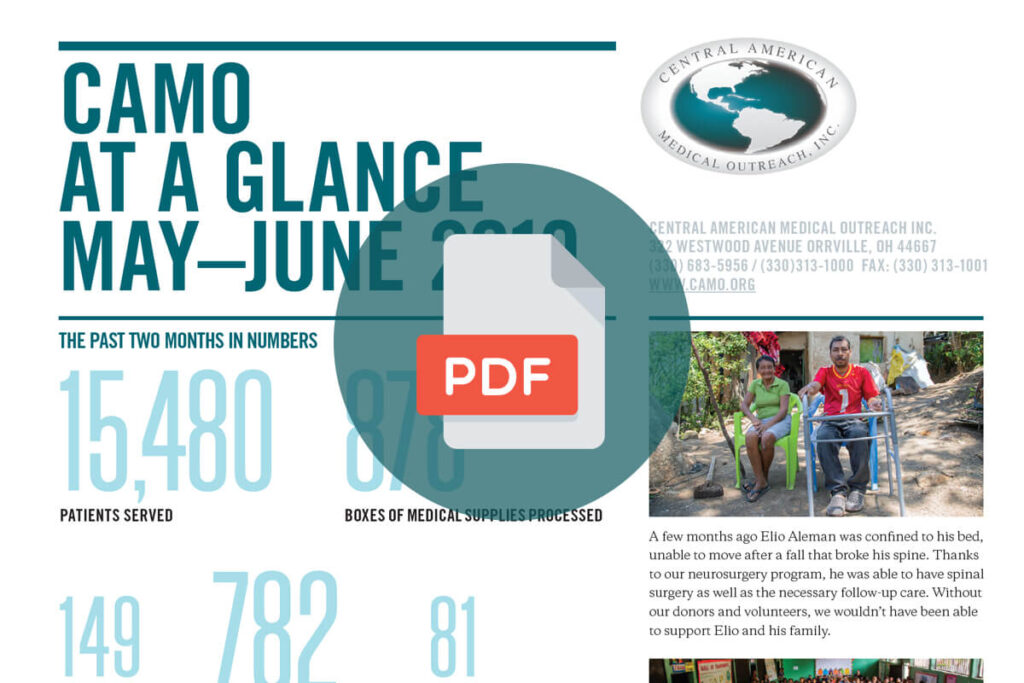
Yes, thanks to our 18 medical programs we have improved the lives of 15,480 children and adults. We are grateful for the support you have given us to make this possible. Thank you!
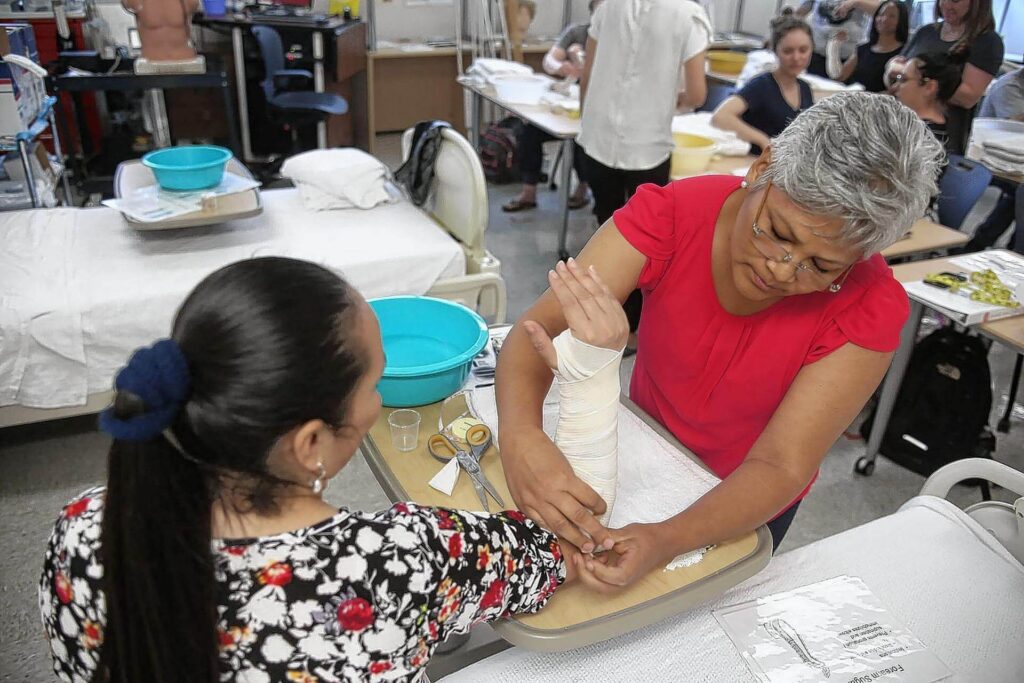
Otterbein University’s nursing program is extending its reach beyond Westerville with the help of its Healthcare Education Simulation Station.
It recently provided a group of nurse educators from Honduras access to hands-on training and low-cost equipment to help train nurses and save lives in their own country.
Jeff Becker, chief maker at edgeThingZ, a product-realization hub at Otterbein, is partnering with Central American Medical Outreach to provide a low-cost classroom technology program in partnership with Otterbein’s nursing department, according to Jenny Hill, a university spokeswoman.
The university’s HESS offers an alternative approach to high-cost nursing-simulation equipment to benefit nursing education and nursing outcomes globally. The HESS system costs $49 per month to provide, compared to the $100,000 a high-tech training mannequin can cost and $1 million for a full-simulation center, according to Hill.
Central American Medical Outreach Inc. is a nonprofit that strengthens health-care systems and provides support for sustainable community development in central America, according to its website, camo.org.
The organization has a headquarters in Santa Rosa, Honduras, a city that is home to five universities. Services provided or supported by CAMO include a domestic-violence shelter, a community gym, a trade school, a daycare center, a cultural center, literacy programs, medical programs and research, and a public health center.
Kathy Tschiegg started the program outreach program in 1993 after the conclusion of her Peace Corps service in Honduras. She said she was devastated about the loss of 31 babies during her last month of service in the 1980s. The deaths were a result of not having the supplies, equipment and educated staff, she said. She said she returned in 1989 and found conditions were even worse than when she left in those terms.
“At that point, I started thinking about how I make a program to solve those problems,” she said.
Otterbein, CAMO and edgeThingZ teamed up to make the training available through the HESS system. The system uses various devices, such as a pulse oximeter and thermometer, that can simulate the required key vital signs for a variety of healthcare-simulation scenarios. The devices can be used with less expensive, low-fidelity mannequins and even human actors, according to the university’s website.
Becker said the technology is being used by nursing education programs at Ohio State University, Kent State University, Wittenberg University, Marion Technical College, Mercy Health and others, according to a university press release.
A group of four nurse educators from four universities were brought to Otterbein for training May 17-19. Ana Julia Melgar Martines,Thania Lineth Estinal Aguilar, Kenia Daliceyh Calderon and Teresa Maribel Carrillo Salgado are all nurse educators who were able to receive training in real-life scenarios with the HESS system.
“These seven days helped me to learn very much and it was very good with the nurses of the other universities. We have learned another way that is an economical way and will help us to elevate our scientific principles. It will help us in advancing the skills of our students,” Salgado said.
She also said it was a great experience to meet other nurses passionate about education.
Tschiegg said this training is life changing because of the reduction in cost.
Tschiegg said she’s hoping the HESS system and training can also be a chance for the country to move forward past poverty and crime.
“They want their country to be better,” Tschiegg said. “These doctors and nurses are passionate about what they do and they love their country,” she said. “I think that says a lot.”
Source: https://www.thisweeknews.com
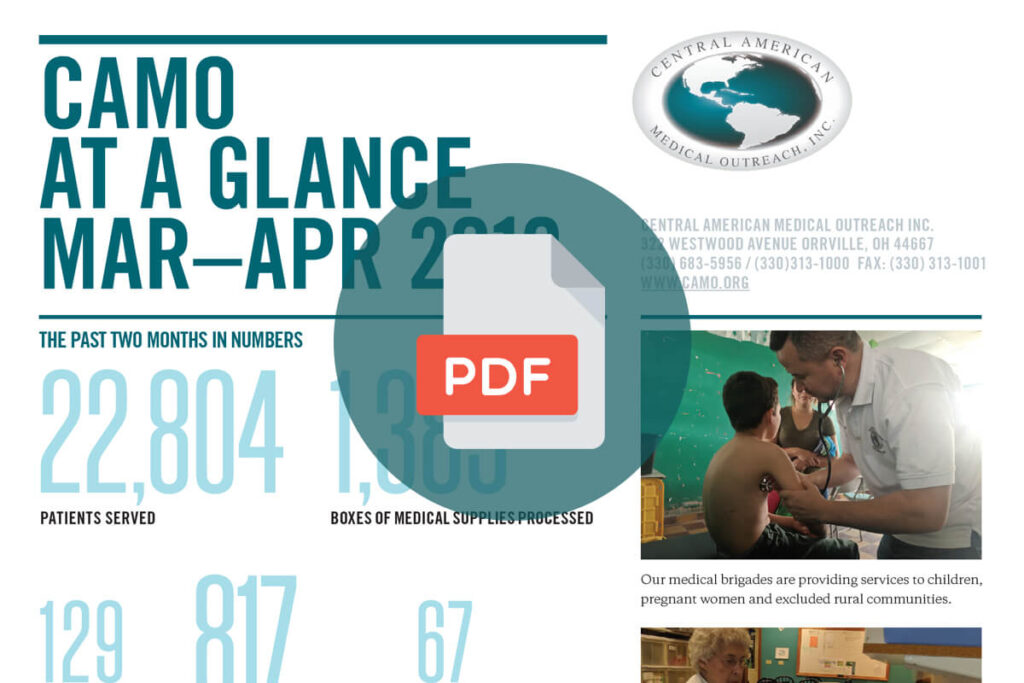
22,804 PATIENTS were served with our medical, educational and community development services these past months. And it was possible thanks to your support, time, talents and donations shared with us. Please take a look at our impact in numbers-and share our stories of hope.