Strengthening Central American health care systems and promoting sustainable development.

News Media Releases

Honduran nurses head home with new skills

CANTON, Ohio – A partnership between nurses in Canton and Honduras could save lives in Central America.

The Aultman College of Nursing is teaming with Orrville-based nonprofit Central American Medical Outreach to improve health care in Honduras.

Earlier this summer, four nurses from Hospital de Occidente, the public hospital in Santa Rosa de Copán where CAMO operates, spent four weeks training at Aultman.

It was the start of a multiphase project to standardize nursing care in Honduras, a country where medical professionals aren’t measured by uniform standards, licensing is often based on the honor system and hospitals don’t adhere to protocol.

 – Written by Jessica Holbrook, Canton Repository business writer

Quarterly

Summer 2014

Everyone who knows CAMO has asked me about the children of Honduras coming to the USA. What is the real story? To understand the truth, I must first clarify a few points. I apologize in advance for the length of this editorial, but please bear with me.

Quarterly

Spring 2014

ORRVILLE — Central American Medical Outreach is all about bringing better care through partnerships. In July, Aultman College of Nursing and Health Sciences will partner with Central American Medical Outreach with the goal of bringing an improved standard of nursing care to Honduras.

Quarterly

End of year 2013-2014

It would be easy to become overwhelmed with all the need in a developing country. People ask me questions every day which demonstrate the difficulty of understanding developing countries’ poverty in comparison to that in the USA. The simplest answer is very few effective organizations exist and even fewer social services exist for the poor in a developing country.

News Media Releases

CAMO helps with emergency services training in Honduras

Special to The Daily Record

SANTA ROSA de COPAN, Honduras – The damaged vehicle lays on its side, its victim trapped inside. A swarm of EMS and paramedics surround the car, doing their best to sum up the situation quickly.

“(The) mechanism of injury (in a crash) indicates the method of extraction,” instructs Steve Wood, a captain of the fire department in Munroe Falls. “Stabilize (the scene), then get the patient out as quickly as you can.”

The accident scene is make-believe, but the training is very real. Wood is one of many volunteer health care providers in Honduras with Central American Medical Outreach for a week.

He led rescue training with members of three Honduran fire departments and a paramedic unit in and around Santa Rosa at a scrap metal yard on the edge of the city.

See more on CAMO’s involvement with emergency services training.

  – Written by June Chandler-White

News Media Releases

Central American Outreach dental team travels near and far in Honduras

SANTA ROSA de COPAN, Honduras – Because the dental team has portable equipment, we travel near and far while in Honduras on behalf of Central American Medical Outreach.

We can be on the road for anywhere from 30 minutes to 21⁄2 hours, and we end up in some pretty rustic villages.

A team recently visited the Honduran city to provide medical care. A team from the area usually goes to Honduras each February. The CAMO headquarters is in Orrville.

Traditionally, we go somewhere closer to Santa Rosa on Friday, and this year was no exception. It was an extremely foggy morning as the volunteers (three dentists and four hygienists/assistants) and our Honduran counterparts (seven dentists or dentists-in-training and two bilingual interpreters) climbed into our vehicles and headed out of town.

We seemed to be on the highways for just a few moments before we turned off the pavement onto a narrow dirt road. To our left was the local slaughterhouse where there were hundreds of vultures sitting on the roof ridge and large rocks that lined the open drainage ditch. Their presence was made all the more ominous by being shrouded in the thick fog.

Just past the slaughterhouse we started up a steep, bumpy dirt road, lucky enough to not meet any oncoming traffic. It seemed for every 100 feet we climbed, we went back a decade in time.

We wound down a rutted dirt and rock road that followed the narrow ridge, which to either side was lined with small adobe houses and ground dropping away into the white abyss. We drove past a small, newly painted church and a small school next to it. Most of the time we are in a schoolhouse, and as we passed, it crossed my mind we may have missed our destination.

I began wondering how our large truck was going to turn around. But further up the road we stopped next to a large, single-roomed building sitting on top a rocky incline above the road.

This building was the town’s community center and we had officially arrived in Rodeo (row-day-oh), Santa Rosa.

We asked the neighboring house if we could run an extension cord from one of their outlets since the community center had no electricity of its own. So through a window and across to the center of the room we plugged in our compressor and our clinic was up and running.

By Friday we’ve had lots of practice and our set-up time is down to only 30 minutes. We unload, unpack and turn an empty room into a fully operational dental clinic. And this town was well prepared for us.

They had trucked in lots of tables for our instruments and had plenty of folding chairs that the community residents could use while waiting to register and receive treatment. And how quickly they descended upon the team; as thick as the vultures below.

They came in all sizes– children in their school uniforms, clutching the written permission slips that had been signed by their mothers; old men leaving their horses tied up down the street; and young mothers holding small babies.

As a group we ended up seeing just under 140 patients, most apprehensive at first but all relieved at the end. As we shut down the clinic, repacked our truck and headed back down that rutted, single-lane road, the fog had lifted and we could see all of Santa Rosa below.

And though we were only a few miles from downtown, this was the most rustic village I had gone to in my 17 trips to Honduras — where besides the large number of free range chickens and pigs roaming the village streets, I have never before been in a place where the horses out-numbered the vehicles.

– Written by Mark Gustafson, D.D.S – CAMO Succession Committee Chair

News Media Releases

CAMO helps with emergency services training in Honduras

SANTA ROSA de COPAN, Honduras — The damaged vehicle lays on its side, its victim trapped inside. A swarm of EMS and paramedics surround the car, doing their best to sum up the situation quickly.

″(The) mechanism of injury (in a crash) indicates the method of extraction,” instructs Steve Wood, a captain of the fire department in Munroe Falls. “Stabilize (the scene), then get the patient out as quickly as you can.”

The accident scene is make-believe, but the training is very real. Wood is one of many volunteer health care providers in Honduras with Central American Medical Outreach for a week.

He led rescue training with members of three Honduran fire departments and a paramedic unit in and around Santa Rosa at a scrap metal yard on the edge of the city.

“It’s helpful for someone from (the) United States to train to know the correct ways,” said Maynor Pena, a driver with the Santa Rosa fire department.

After a group of about 15 firefighters carried the shell of an old truck about one hundred yards to the site of the training, instruction began.

On this day, the firefighters and paramedics were learning to extract a victim in an overturned vehicle — covering the victim so breaking glass does not fall on the victim, putting the victim on a backboard to stabilize the spine before moving and providing CPR to the victim when a heart attack occurs once extracted.

“They are a very helpful people,” Wood said, adding the older firefighters are clearly willing to teach their younger counterparts.

“They’re very well trained; they knew what to do,” he said. The firefighters and paramedics “need to be able to work together and that’s why we have the trainings … to work as one group.”

The concept of cross-cultural exchange and education is nothing new to CAMO. Honduran paramedic Juan Ramon Trejo, firefighter Wilmer Cruz, hospital director Dr. Juan Carlos Cardona and emergency room director Dr. Pablo Santos trained with emergency personnel in Canton in January 2013.

“We brought them up to be able to see how triage works, how important it is and how to bring every (medical professional) together from the pre-hospital (treatment) to triage to the patient flow through the emergency room and beyond,” CAMO founder Kathryn Tschiegg told the Canton Repository at the time.

Still, EMS is a relatively new concept in Honduras. Although the rescue workers have some training, the departments lack even the most basic equipment. Wood said the fledgling departments do the best with what they have.

Edgardo Orellana, el Capitan of Santa Rosa de Sula department, expressed gratitude for the equipment and training provided by CAMO.

″(CAMO is) very helpful for the department,” he said.

When the Hondurans were in Canton, the fire department donated to CAMO three HazMat suits that were used for training and rendered useless under federal guidelines. Anyone wishing to help may contact CAMO at its website or call 330-683-5956330-683-5956.

Lance White, managing editor of The Daily Record, was in Honduras in February gathering information on CAMO. June Chandler-White, who works for CAMO, wrote the story.
Quarterly

End of year 2012-2013

Central American Medical Outreach, Inc. (CAMO) would like to thank you on behalf of all the patients who have had life-changing services given to them. On behalf of the community and outlying areas of Santa Rosa de Copan, which did not have a trade school, cultural center, community gym or women’s shelter, we collectively thank you for being a part of making our world a better place for a very large population of people.

Quarterly

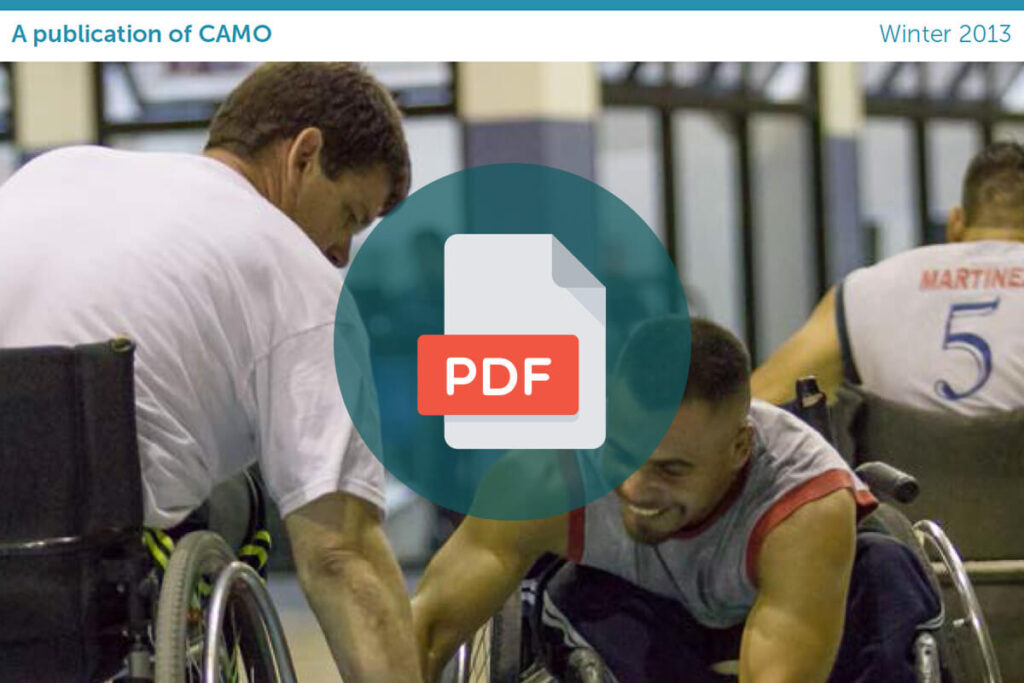
Winter 2013

It’s hard to believe that over 20 years ago, CAMO was just a dream. After my two-year Peace Corps experience ended in 1981, I had to do something more. The people in Honduras needed help. They did the best they could with what they had. But they suffered needless death because they lacked the basics, the simple things that we here in the States often take for granted. So, with a step of faith, I took one duffel bag filled to capacity with medical supplies and hand-delivered it to the Santa Rosa hospital. That’s where the dream began. This year, CAMO celebrated 20 years of service, bringing hope to an otherwise forgotten people.

Quarterly

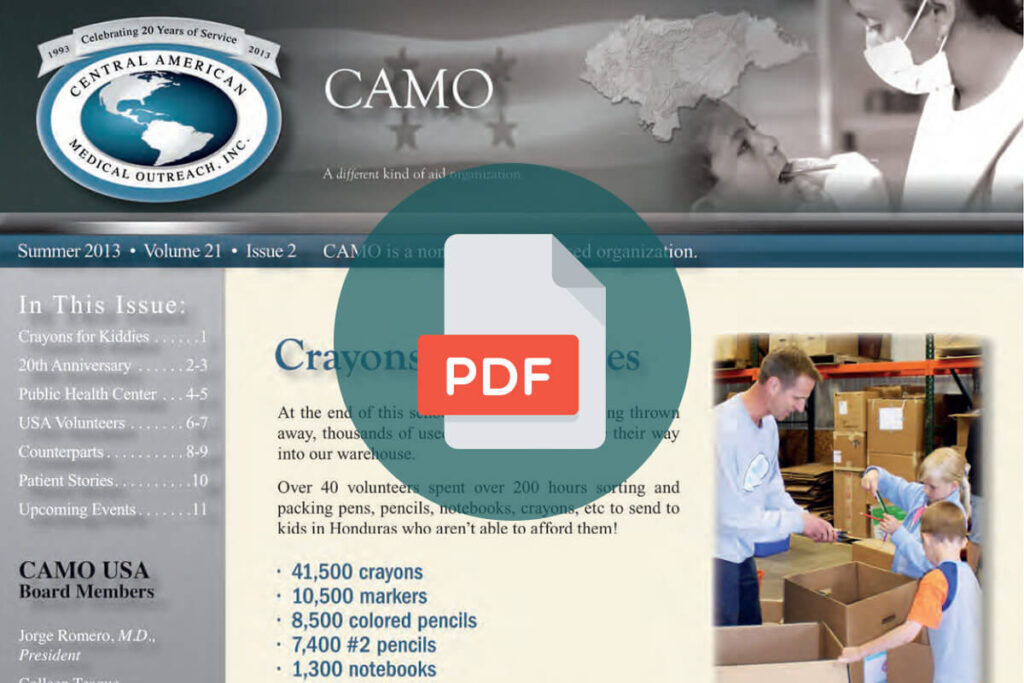
Summer 2013

At the end of the school year, instead of getting thrown away, thousands of used school supplies made their way into our warehouse. Over 40 volunteers spent over 200 hours sorting and packing pens, pencils, notebooks, crayons, etc. to send to kids in Honduras who aren’t able to afford them! We can’t say thank you enough to all the participating schools, teachers, students and volunteers who have helped us get these tools into the hands of children in need.

Scroll to Top